HOME and how to join › Forum › Open Area › General Scott topics › 3 Speed Gearbox Numbers ?
Hi, I’m a new member here and of course my first post is a question.
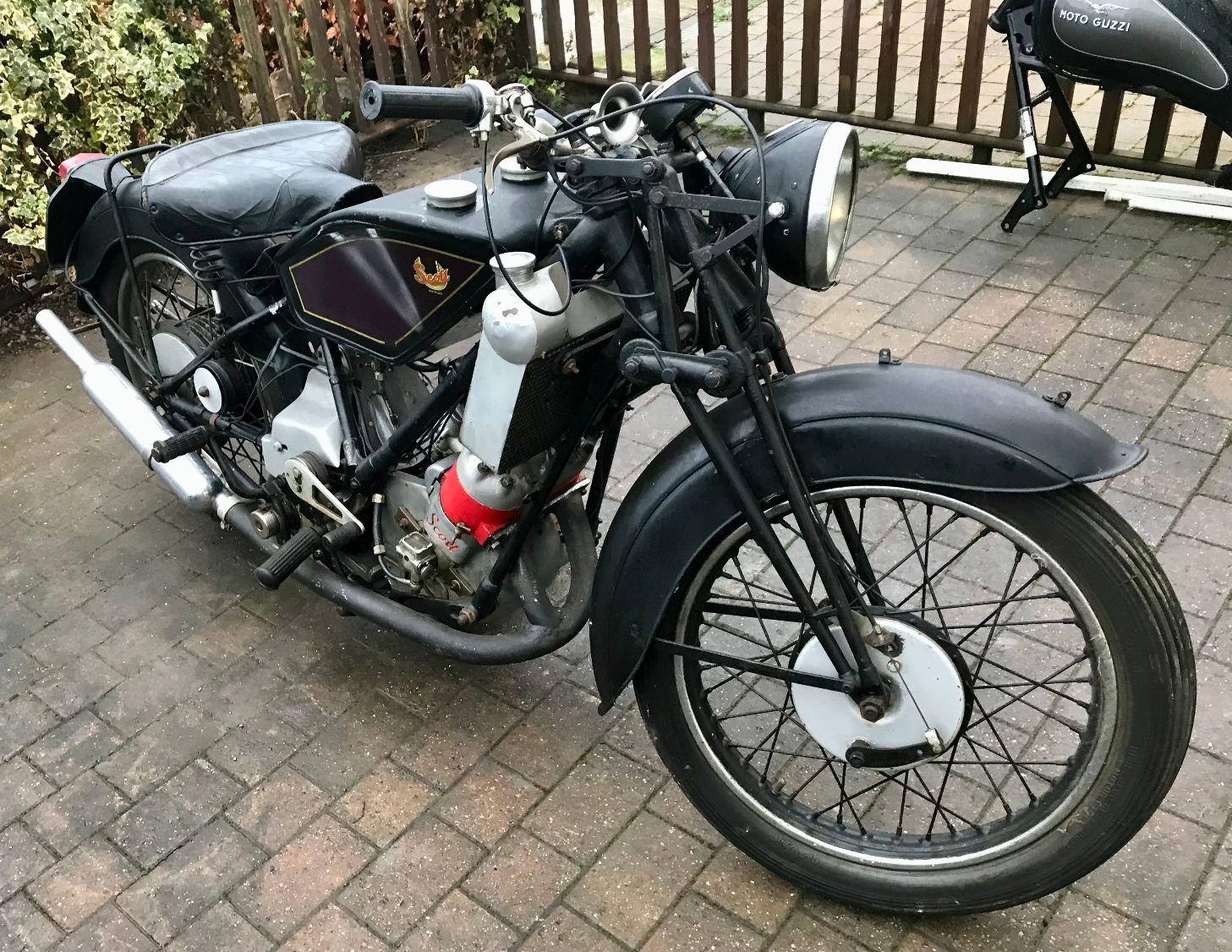
I’ve recently bought a 1947 Flying Squirrel and I’m in the process of getting the factory records from the VMCC for it, they are asking me for the gearbox number, I’ve had a good look at everything I can see but cant find them, can anyone help ?
Interestingly chatting with the VMCC records chap it sounds like this bike is one of the 12 bikes built in late 1946 and one of the last fitted with Brampton girder forks, there are few other odd bits too as it has the big 1947 back brake and fully valanced mudguards, hopefully the factory records will give a bit more information.
regards, Keith
Also if I could just get the thing to start it would be a bonus, its fitted with an aftermarket coil conversion which is sparking although I have had to remove it and it no longer has horrible bodged wiring, while was there I’ve accurately found Top Dead Centre and marked it on the flywheel along with 1/4″ and 5/16″ before TDC. Its relatively easy to set the timing now although its still refusing to start.
Its got some rather odd spark plugs fitted with triple points around the central electrode, I’ve never heard of a Binks M3 plug before, it does look a bit short reach but I’ve fitted some NGK B6ES with adaptors for now and they are actually the same installed length.
The carbs all nice and clean although it drips a bit but that’s probably down to flooding it and it not starting !
It seems to have decent primary & secondary compression too.
I’ll persevere a bit more but I’ll be taking it to bits soon, well its in a queue and it pushed in front, its about to go to the naughty corner while I finish a Guzzi that’s sat on the bench neglected
And if anyone can explain the comedy repair to the exhaust front pipe I’d be interested to know ?
It depends on which end cover is fitted to your gearbox. It looks from your picture that you have a hand change box that has a foot change adapter bolted on, in which case the number will be on a flat area just above the kick start boss. Any letters will refer to the gear ratios ie CM – close medium, W – wide, C – close. Gearboxes with the gear change housing cast into the end cover will have the number stamped on the flat circular area that houses the main shaft bearing just behind the foot rest.
1946 models according to the brochure were fitted with 8” full width rear hubs and with twin 6” full width front hubs. My Brampton forks are fitted with the twin full width hub.
It’s probable that the factory fitted what ever was available, as many parts and materials were not available during the early post war period, so nothing can be ruled out!
Dave
You can take the plugs out and kick it over on full throttle to see if you get a nice popping sound from the primary compression, also take a crankcase door off to see if it needs baling out. Maybe try QuickStart to see if it will fire or even swap the plug leads over to make sure they aren’t the wrong way round. Fresh petrol? Good luck, looks a sound project.
The exhaust pipe was/is prone to rusting at that junction if the chrome plating was poor. The repositioning probably indicates the nearest place that they could find sound metal to weld to!
Dave
Thanks Dave, I found it once I removed the gear change mechanism, it was tucked underneath where there’s a double thickness of steel. I was expecting to find it on the body of the gearbox but it’s on the end cover.
I think the first versions of the gear change were the steel version and the alloy end cover came in a bit later, my bike has no fittings for a hand change so must of come like that.
Richard, I’ve done all of that, the ignition fires both plugs together so you can’t mix up the leads.
And for the first time in my life I even resorted to easy-start, the best I managed was one loud bang !
Apologies for telling you what you already knew
Richard, sorry wasn’t meaning to sound grumpy at all, I’ve had another look at it tonight and still getting nowhere, I’m going to pull the engine to bits, check everything and sort out a damaged engine mount then go from there, there’s something a bit odd going on so a fresh set of gaskets and check the crank and glands will be a good place to start I think. Problem is I’ve lots of other things I need to do other than play with the Scott, I’ve a Guzzi that needs finishing off after a clutch replacement and I was supposed to be working on my T140D Bonnie after that not buying a Scott ?
That’s fine Keith, I don’t take offence at all easily, I wasn’t grumpy just a bit embarrassed to have been too basic to someone who knew what they were doing. let’s hope it’s something straightforward, will look foreword to hearing more
Hi Keith, my 1946 has the big rear hub/brake, Brampton forks and twin drum front brake. It was registered 31/12/46 I was also led to believe that the factory would have used whatever they had on the shelf to build a complete bike that year. I also believe my frame was made before the war but built after.
Kevin
Hi Kevin, I’ve been provisionally told my bike was built in November 1946 and I know it was registered in March 1947, it obviously doesn’t have the double sided front brake, I’m not even sure if it’s a Scott front brake as it has what looks like an aluminium cover plate over it but then so does the rear one
That’s how mine came, drum both sides, a strange set up

The rear brake plate is correct but I’ve never seen an aluminium single front brake plate on a Scott. I doubt that it was fitted by the factory.
I’m no expert on starting but have suffered many issues. The advice I was given was to drain the crankcases, fresh petrol, check for leaks on the transfer ports and doors etc. I worked through these one by one, and also cylinder sealing and rings. Anyway, my 2 pennies worth is to do exactly what you are thinking. Remove the engine and check everything, otherwise you might drive yourself around the twist.