HOME and how to join › Forum › Open Area › General Scott topics › Fresh blood!
It’s interesting that you’ve both spotted that! It was a question I was going to ask, as all the museum Scotts of a similar age to DJY have the ‘rocker’ stand too – and it looked to my uneducated eye like a really clever and probably more stable engineering solution than a modern kick-stand. DJY effectively has THREE stands then; the kick stand, the big rear stand and a twin ‘H’ shaped stand under the front of the engine which I guess could be extended to change the front wheel.
I wonder, if the bike was specc’d to have all three whether the original purchaser imagined he was going to do a bit of touring – and therefore having the big rear stand and the front stand would make taking the wheels of for punctures a lot easier, single handed and out on some remote road?
I’ve also been amused to see the ‘push bike’ style lugs to take a standard push bike tyre pump! Was that a standard feature on Scotts too?! 😛
@BRIAN MARSHALL wrote:
In 1946 they only built 12 bikes, six with Webb forks and six with Brampton girder forks, and photos suggest that they had rear stands. There is therefore a possibility that bikes built in early 1947 also had rear stands, despite the change to Dowty Oleomatic forks.
Brian
My ’47 also has a rear stand. As you are aware, however, mine is hardly a beacon of originality so it may have been added in the 70’s when it was restored.
It may be of interest to Toby that I rebuilt my Dowty forks a few years back and they still hold air well!
Keith
Toby, Even the Isle-of-Man Senior TT works Scotts carried a push-bike type tyre pump, however they have a foot stirrup attached to them, so are not quite like a typical push-bike pump. You can buy an old one or a new ‘repro’ one quite easily.
Brian
Gammakeith – thanks for the info! It is interesting, isn’t it? The rear stand looks a bit like an ugly afterthought to my mind compared to the sinuous ‘rocker’ stand which tucks away neatly, but as my pa pointed out, with the fore and aft stands, wheel changes and tyre repairs are a LOT easier!
Brian – I’ll add a pump to my shopping list – I think it would be fun (and practical!) to fit her with one.
The rear stand and tyre pump were standard fitting on most British medium to large bikes before WW2.
Brian
I’m sure someone can correct or confirm this but I think the frame with the centre stand has gearbox mounting brackets (lugs) integral to it with an extension on each side to take the stand bolt. If your gearbox is held by brackets which bolt around the frame then you will have a rear stand as original fit.
My 1948 frame has the gearbox/centre stand brackets brazed to the frame. On two of my pre-war Scotts, I have fabricated new gearbox clamp on brackets with extensions to fit the roll on centre stand as I am now finding it too strenuous to pull the bikes on to the rear stands and which are still in situ should I need them.
My ’47 has the roll-on centre-stand, and when I see my fellow old gray-beards attempting to haul bikes like Hinckley Bonnies onto thier’s I thank the designer who had the good grace back then to make something so useable.
Mind you, such a complex casting must have eroded the profit margins even further… 😉
Yes, typically Scott I suppose
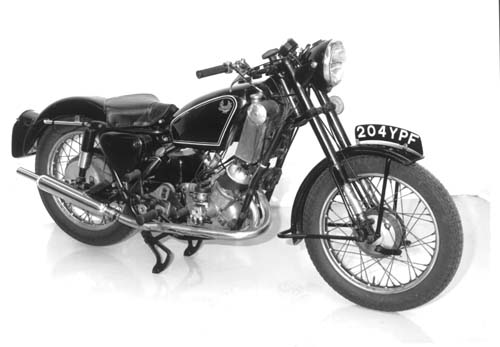
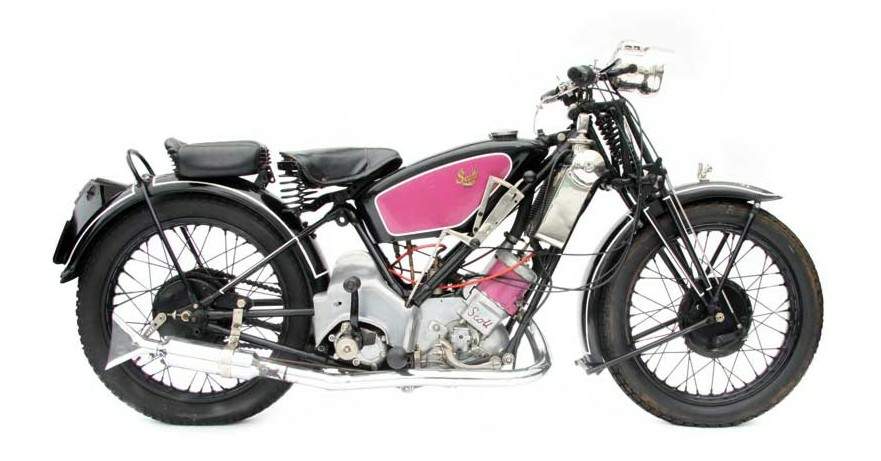
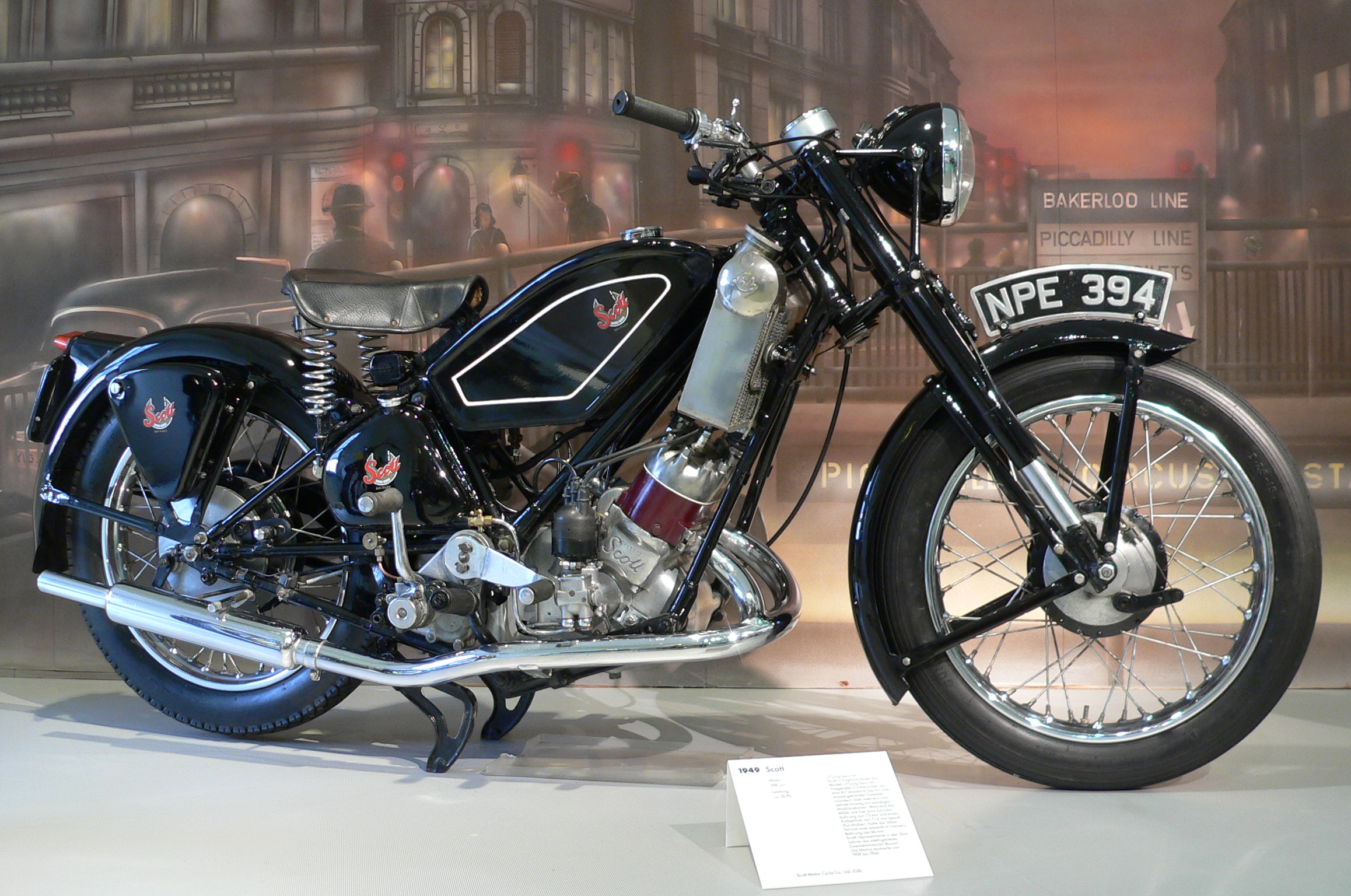
Just a quick recap on rear facing versus forward facing brake levers on the drums – I’ll follow recommendation and remount our front wheel with the levers facing backwards as per brochure pix and advice here – but here are some pics of other bikes of various ages and specs with the levers facing forwards:
https://images.wemoto.com/news_site/2012/11/06-uid71/scott%20B.jpg
https://motorcycle.com.vsassets.com/blog/wp-content/uploads/2015/06/062415-1939-scott-flying-squirrel-f-633×388.jpg (on oleo forks)
https://www.motorcyclespecs.co.za/Classic/Scott%20Flying%20Squirrel.jpg
https://www.yesterdays.nl/images/Scott-19290-i-1.jpg
https://upload.wikimedia.org/wikipedia/commons/a/a7/ZweiRadMuseumNSU_Scott_1949.JPG (on oleo forks)
…. ❓
I’m running a ’47 and the levers point rearward on the twin drum setup
The first picture in Toby’s set of pictures is of a late Birmingham Scott and has a Shipley 6″ brake fitted instead of the larger Brum brake.
Many girder fork Scotts had rod operated brakes (the rod running from the cable adjuster on the fork, to the brake arm), so there was no option but In to have the brake arm pointing forward.
In any case, I can’t see that it makes any difference with single leading shoe brakes as the brake cam is symmetrical.
Dave
I have posted a similar reply to this question before, there is a reason why brake levers should point forward and not backwards as Scotts supplied them, and the reason is this, although the brake cam lifts both shoes the edge of the cam nearest the spindle will lift its shoe slightly more than the edge of the cam further from the spindle lifts its shoe, so the brake shoe nearest the spindle should be the leading shoe, this can only happen if the brake levers are pointing forward, if you copy Scotts original design you will be putting all your effort into braking with the trailing shoe. Having said all this the Shipley 6″ front brake is entirely let down by weak shoes and backplates that just distort when applied. Over the years owners have also unjustly blamed the 2 into 1 cable junction box for the poor brake performance, this has nothing to do with it and is no different to the Royal Enfield twin cable lever fitted to Birmingham Scotts, on both types 1″ of cable movement at the handlebar will lift both brake levers by 1″ , the Vincent system is 2 to 1 ratio, 1″ of cable movement on the handlebar lever will only move the brake levers 1/2″. If anyone decides to alter their brake levers to forward facing please just change the backplates and not the whole wheel as the threaded ring locking the bearing should always be on the left of the machine. Alan Noakes. scottworkshop@hotmail.co.uk
It may “lift” the same amount, but the “pull” is halved. Heavy duty cables and new brake linings make it work OK though.
Thanks for the locking ring info Alan, I recommissioned a 49 Scott last year and although the front brake was OK it didn’t give the owner a great deal of confidence. I now have the bike back to fit a set of Rogers cranks and to do something at the front brake, last year I had difficulty placing the cables so they had a decent pull, I moved the compensator forward and rearward but could not get a good position for the cables. This time I dropped the wheel out and swapped the brake plates to opposite sides so the levers point forward by doing this the cables have now got a straight pull and the braking effect has dramatically improved. It may not look original as per Scott drawings but it now works, safety is better than looks. Kev